

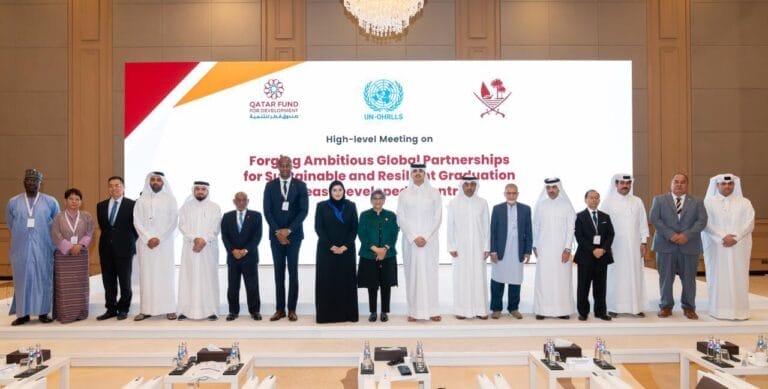
Global Leaders Convene in Doha to Advance Sustainable and Resilient Graduation for Least Developed Countries
Doha, 2 December 2025 – Today, State of Qatar hosts a pivotal High-level Meeting on “Forging Ambitious Global Partnerships for Sustainable and Resilient Graduation of Least Developed Countries (LDCs)”, bringing together ministers and senior officials from graduating and graduated countries, development partners, and UN entities to chart a renewed course for sustainable graduation from the LDC category.
The meeting, co-organized by the State of Qatar through Qatar Fund for Development (QFFD) and the United Nations Office of the High Representative for Least Developed Countries, Landlocked Developing Countries and Small Island Developing States (UN-OHRLLS), underscores the urgency of ensuring that graduation becomes a gateway to resilience and prosperity rather than a point of vulnerability.
The three-day event builds on the Doha Programme of Action (DPOA), adopted at the Fifth UN Conference on LDCs. The DPOA sets an ambitious target: enabling 15 additional LDCs to meet graduation criteria by 2031. With eight countries already graduated and 14 more on track, this decade marks a historic turning point for the world’s most vulnerable economies.
H.E. Dr. Maryam bint Ali bin Nasser Al Misnad, Minister of State for International Cooperation of Qatar, opened the meeting reaffirming Qatar’s leadership in advancing the DPOA: “Qatar considers empowering the least developed countries (LDCs) to be part of its international responsibility and its unwavering commitment to promoting multilateral development. Therefore, Qatar supports the efforts of the United Nations, particularly the Office of the High Representative for the Least Developed Countries, Landlocked Developing Countries, and Small Island Developing States, in coordinating and guiding UN action to achieve tangible results for these countries.”
Ms. Rabab Fatima, UN Under-Secretary-General and High Representative for LDCs, highlighted the significance of this moment: “Graduation must not be a point of vulnerability. Rather, it must serve as a launchpad for sustained resilience, inclusive growth, and long-term partnership. This meeting offers us a valuable opportunity to mobilize transformative partnerships, reinforce mutual accountability, and shape actionable policies that enable every graduating country to move forward with confidence, enhanced capacity, and renewed optimism.”
H.E. Mr. Amrit Bahadur Rai, Foreign Secretary of Nepal and Chair of the LDC Group, stressed the need for predictable support: “To overcome the challenges which persist in our interconnected and interdependent world, there is no other way than to have robust global solidarity and partnerships. Partnerships that are transformative not piecemeal; substantive not symbolic; wholehearted not halfhearted – partnerships that both match the scale of the challenges and the urgency of the moment.”
The LDC category was established by the UN General Assembly in 1971 to provide special international support to countries facing severe structural impediments to sustainable development. Today, 44 countries remain in the category, down from a peak of 52. While graduation signals progress, many countries continue to grapple with narrow production bases, high debt burdens, and climate-related shocks. These vulnerabilities often intensify as LDC-specific support measures phase out after graduation, creating what experts call “graduation cliffs.”
The DPOA responds to these challenges with a bold, incentive-based framework that prioritizes resilience, structural transformation, and inclusive growth. It calls for predictable, phased transition arrangements, tailored to each country’s needs, and backed by strong international partnerships.
Three years into implementation, the DPOA is moving from vision to action through a suite of innovative tools designed to support countries before, during, and after graduation:
• Food Stockholding Mechanism – to strengthen food security and buffer against shocks.
• Resilience-Building Mechanism – to help countries anticipate and manage crises.
• International Investment Support Centre – to attract diversified and sustainable investment flows.
• Online University for STEM – to build human capital and technological capacity.
• Sustainable Graduation Support Facility (iGRAD) – a flagship initiative providing tailored, demand-driven technical assistance.
The iGRAD facility represents a new generation of support for graduating countries. It offers:
• Smooth Transition Strategies (STS) – helping countries plan and implement measures to offset the loss of LDC-specific benefits.
• Access to Non-LDC Financing – improving capacity to tap into broader development finance opportunities.
• South-South and Triangular Cooperation – fostering peer learning and knowledge exchange among countries at different stages of graduation.
By aligning with national priorities and responding to country-specific vulnerabilities, iGRAD ensures that graduation is not just a statistical achievement but a sustainable development milestone.
The convening aims to produce actionable recommendations to operationalize iGRAD, strengthen UN system coordination, and promote financial innovation. These outcomes will feed into the midterm review of the DPOA, scheduled for Doha in 2027, and help shape a global consensus on an incentive-based graduation framework.
For media inquiries, please contact: comms@qatarfund.org.qa
- Geography Qatar
- Timeline 2025